When we go out on a teardrop camping trip, we are limited by space. Our food takes up the majority of the galley area, but we do find room to take a few items that add a little more spice to our meals. There are a few handy condiments that always make it along on every trip, and each can do double or triple duty.
Bragg's Liquid Aminos
Rather than soy sauce, we bring a small container of Bragg's Liquid Aminos. The sauce tastes just like soy sauce, but without all the sodium. We use the aminos in everything from marinades to salad dressing to fried rice.
Cholula Hot Sauce
We really can't go on any camping trip without Cholula Hot Sauce. It's not overly hot and has a really nice, piquant flavor that goes great with everything from eggs and burritos to corn on the cob. We prefer the original flavor.
Kirkland Signature Imported Pesto
I put pesto on everything from pasta to sandwiches. It's also great in potato salad, on wraps and even on scrambled eggs. Unfortunately, it does need to be refrigerated, so it's a condiment that we have to keep in the cooler. We bring a small container of the Kirkland Signature Imported Pesto from Costco since the original container is too large.
Kikkoman Seasoned Rice Vinegar
You can tell we like our Asian flavors. We love to bring along a bottle of Kikkoman's Seasoned Rice Vinegar for everything from quick pickles to salad dressing. It's also a good marinade for fish.
Lea & Perrin's Worcestershire Sauce
No camping trip is complete without burgers or steak. We like to generously dose our meat with Lea & Perrin's Worcestershire Sauce. The sauce is also another great marinade for ribs or skirt steak.
Showing posts with label food. Show all posts
Friday Teardrop Photo
For some reason, the photos of us stopped for a teardrop trailer lunch on the road are very popular. Personally, I do love stopping in a parking lot or a public rest stop for lunch out of the teardrop. The looks we get are priceless.
At this stop we are having turkey and cheese spread sandwiches on pita bread with grapes and water. Ahhh...the luxurious life of a teardropper.
Friday Teardrop Photo
To make it easier for these types of meal breaks, and so you don't have to break out the propane or stove, always have these types of food in the galley or ice chest: bread, crackers, cheese, hard boiled eggs, mayo, fruit and vegetables, canned tuna, chips and salsa, salt, pepper and spices, soda and water. Cleanup should be easy with just a quick wipe of a paper towel.
Friday Teardrop Photo
Our good friend Nelly and our teardrop galley very full of food for two weeks of camping in Grand Teton and Yellowstone. The galley usually becomes the bar while we are set up in camp. Nelly, the tica, likes margaritas sans lime.
Shot in the beautiful Gros Ventre Campground in Grand Teton National Park.
Five Favorite Dutch Oven Recipes
Teardrop camping and Dutch oven cooking go together like peanut butter and jelly. I had never cooked with a Dutch oven before getting a teardrop and seeing the pros at the various gatherings tackle the heavy cast iron pots. The cooking method was clinched for me while on a trip to Zion National Park. A nice couple with a vintage canned ham trailer were in the process of making a divine beef stew over the fire and as I watched them top the stew with homemade biscuits, I was hooked.
I'm still a Dutch oven novice and have not done any cooking using briquettes. When we go camping with our other teardrop friends, we only use coals from the fire to keep from having to bring all the briquette cooking accoutrements. We make the process easier and safer by placing both the coals and the Dutch oven in a galvanized steel pan. Other Dutch oven necessities are aluminum foil, a shovel for digging out coals, a pair of welding gloves to lift up hot, heavy pots and of course, a lid lifter.
While we do some experimenting with Dutch oven cooking, we do tend to gravitate toward the same couple of recipes. These are my five personal favorites:
Dutch Oven Quiche
This is a super simple dish for both breakfast and dinner. You will need a Dutch oven large enough to fit your pie crust, but you can just leave it in its original tin. You can also make the quiche in aluminum foil right in the oven (see photo above). I got this recipe from the Texas Park & Wildlife video on Dutch oven cooking.
Dutch Oven Pizza
This is my all-time favorite teardrop dinner. I got the recipe from fellow teardroppers, Dean and Joannie's YouTube channel, Outdoor Cast Iron Cooking. They have a ton of great recipes and videos on how to make some really tasty cast iron dishes. We use their pizza recipe over and over again. The parchment paper and corn meal are essential.
Dutch Oven Lasagna
This is another Dean and Joannie recipe that takes a little longer to make, but is so tasty and filling, especially when you are camping in the cold. It creates a lot of liquid, so I tend to use less cheese and drain out the meat.
Mountain Man
Another recipe by Outdoor Cast Iron Cook is Dean's Mountain Man breakfast, which I've had with him on the California coast and it was the perfect breakfast for a chilly, foggy morning. We've done several variations of this recipe with different meats and veggies.
Dutch Oven Chuck Wagon Casserole
Can you tell I lean toward classic Western cowboy dishes? The Chuck Wagon Casserole with corn, chilis and cornbread is the quintessential Dutch oven dish and is quick to make. I got the recipe from Dutch Oven Dude. In fact, any kind of casserole does well in a Dutch oven. Experiment.
We've learned a few things while teardropping and Dutch oven cooking: this type of cooking takes longer than you think it will, especially when it's cold out, so be sure to have some appetizers while waiting. Also, when you start smelling your dish, it's ready. Remove it from the coals and check it to make sure it doesn't get burned.
There's a learning curve that comes with Dutch oven cooking, and it takes some practice with different recipes to get the hang of it.
I'm still a Dutch oven novice and have not done any cooking using briquettes. When we go camping with our other teardrop friends, we only use coals from the fire to keep from having to bring all the briquette cooking accoutrements. We make the process easier and safer by placing both the coals and the Dutch oven in a galvanized steel pan. Other Dutch oven necessities are aluminum foil, a shovel for digging out coals, a pair of welding gloves to lift up hot, heavy pots and of course, a lid lifter.
While we do some experimenting with Dutch oven cooking, we do tend to gravitate toward the same couple of recipes. These are my five personal favorites:
Dutch Oven Quiche
This is a super simple dish for both breakfast and dinner. You will need a Dutch oven large enough to fit your pie crust, but you can just leave it in its original tin. You can also make the quiche in aluminum foil right in the oven (see photo above). I got this recipe from the Texas Park & Wildlife video on Dutch oven cooking.
Dutch Oven Pizza
This is my all-time favorite teardrop dinner. I got the recipe from fellow teardroppers, Dean and Joannie's YouTube channel, Outdoor Cast Iron Cooking. They have a ton of great recipes and videos on how to make some really tasty cast iron dishes. We use their pizza recipe over and over again. The parchment paper and corn meal are essential.
Dutch Oven Lasagna
This is another Dean and Joannie recipe that takes a little longer to make, but is so tasty and filling, especially when you are camping in the cold. It creates a lot of liquid, so I tend to use less cheese and drain out the meat.
Mountain Man
Another recipe by Outdoor Cast Iron Cook is Dean's Mountain Man breakfast, which I've had with him on the California coast and it was the perfect breakfast for a chilly, foggy morning. We've done several variations of this recipe with different meats and veggies.
Dutch Oven Chuck Wagon Casserole
Can you tell I lean toward classic Western cowboy dishes? The Chuck Wagon Casserole with corn, chilis and cornbread is the quintessential Dutch oven dish and is quick to make. I got the recipe from Dutch Oven Dude. In fact, any kind of casserole does well in a Dutch oven. Experiment.
We've learned a few things while teardropping and Dutch oven cooking: this type of cooking takes longer than you think it will, especially when it's cold out, so be sure to have some appetizers while waiting. Also, when you start smelling your dish, it's ready. Remove it from the coals and check it to make sure it doesn't get burned.
There's a learning curve that comes with Dutch oven cooking, and it takes some practice with different recipes to get the hang of it.
How do you keep your food cold?
Most teardrop trailers do not have the luxury of a full refrigerator. With limited galley space, most teardroppers rely on ice coolers and sometimes 12-volt portable coolers to keep their beer and steaks cold. There are several different ways to keep your food cold if you own a teardrop trailer and there are advantages and disadvantages to both of them.
So far, my husband and I have only used a regular cooler filled with ice to keep our food cold. We previously had a Coleman, but we've since upgraded to a "bear proof" and lockable cooler since we tend to camp in hungry bear territory. The advantages of this way of storing cold food is that these coolers don't use power and keep ice cold for at least 2-3 days depending on the outside air temperature. The disadvantages are that every 2-3 days we have to go hunting for ice which can sometimes run about $3-$7 a bag. On our next big trip, we are going to try to use dry ice. Another disadvantage to our particular teardrop design is that the galley does not have space for the cooler, so we have to keep it outside of the teardrop, and in bear territory, that means having to pack it away in the car at night or when we leave our site. All that lifting is hard on the back.
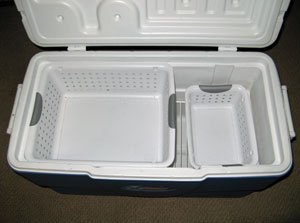
One thing that we have done with our cooler to keep melted ice from mixing with our food is to separate the food from the ice with a clear, plastic storage bin. We bring the bin into the house and fill it with our food and then carry it out to the cooler, place it inside and then pack the ice around it. The ice and the food stay separate and we can also use that clean ice for our margaritas.
Another tip I've seen from teardroppers is to line the sides and the top of your cooler with a reflective, insulation. These are sometimes called radiant barriers or bubble foil and are sold in rolls that you can cut to the size of your cooler.
Some teardroppers are lucky to have enough space in their galley to hold a small 12-volt cooler. These types of coolers can run off the teardrop or car battery or can be hooked up to a solar panel on the roof of the trailer. There is no need to buy ice and the cooler keeps food at a consistently 36 degree temperature. The disadvantage is that these types of coolers are pretty small (about 15-17 liters) and some food will need to be frozen or cooled before putting them into the 12-volt cooler. Also, if you are camping for a long time, you may need to have access to campground power to make sure your battery does not get drained.
So far, my husband and I have only used a regular cooler filled with ice to keep our food cold. We previously had a Coleman, but we've since upgraded to a "bear proof" and lockable cooler since we tend to camp in hungry bear territory. The advantages of this way of storing cold food is that these coolers don't use power and keep ice cold for at least 2-3 days depending on the outside air temperature. The disadvantages are that every 2-3 days we have to go hunting for ice which can sometimes run about $3-$7 a bag. On our next big trip, we are going to try to use dry ice. Another disadvantage to our particular teardrop design is that the galley does not have space for the cooler, so we have to keep it outside of the teardrop, and in bear territory, that means having to pack it away in the car at night or when we leave our site. All that lifting is hard on the back.
One thing that we have done with our cooler to keep melted ice from mixing with our food is to separate the food from the ice with a clear, plastic storage bin. We bring the bin into the house and fill it with our food and then carry it out to the cooler, place it inside and then pack the ice around it. The ice and the food stay separate and we can also use that clean ice for our margaritas.
Another tip I've seen from teardroppers is to line the sides and the top of your cooler with a reflective, insulation. These are sometimes called radiant barriers or bubble foil and are sold in rolls that you can cut to the size of your cooler.
Some teardroppers are lucky to have enough space in their galley to hold a small 12-volt cooler. These types of coolers can run off the teardrop or car battery or can be hooked up to a solar panel on the roof of the trailer. There is no need to buy ice and the cooler keeps food at a consistently 36 degree temperature. The disadvantage is that these types of coolers are pretty small (about 15-17 liters) and some food will need to be frozen or cooled before putting them into the 12-volt cooler. Also, if you are camping for a long time, you may need to have access to campground power to make sure your battery does not get drained.
Teardrop Trailer Food
When teardrop camping, we have a tendency to bring along the same types of food. This is really because we have limited storage space and usually we want to spend our time outside hiking, kayaking or enjoying other outdoor sports. We don't want to spend our time figuring out new recipes. So we have gotten into the habit of bringing along our favorite things every time we head into the hills.
Most of our dinners are cooked in a dutch oven which goes hand-in-hand with teardrop camping, and which I will cover in a future post. However, a lot of our meals are also cooked over the propane stove or over the campfire, and because we've been out and about all day our favorite foods and drinks tend to be high in calories.
Our camping standbys are:
Breakfast
Bagels (toasted on the stove or over the fire) and cream cheese
Grapefruit
Orange juice
Eggs (sometimes mixed with cheese or sweet peppers)
Bacon
Toast
Tortillas
Pancake mix and syrup
Coffee
Lunch (usually eaten on a trail or on a kayak beach)
Tortillas (we love quesadillas with turkey or ham)
Bread and cold cuts
Tunafish salad
Pickles
Apples and oranges
Cheese
Happy Hour
Tortilla chips and salsa
Olives
Hummus and veggies
Crackers and goat cheese
Alcohol
Pre-mixed margaritas (and a few limes)
Beer with twist caps
Wine with twist caps
Dinner
Various dutch oven meals (stews or pizza are our favorites)
Steak
BBQ Chicken
Steamed veggies in aluminum foil on the fire
Grilled veggies
Desserts
Jiffy Pop popcorn
Roasted Marshmallows or S'mores
Hot Chocolate
Dutch oven brownies or upside down pineapple/peach cake
No matter what we bring, it always tastes much better out in the fresh air.
Most of our dinners are cooked in a dutch oven which goes hand-in-hand with teardrop camping, and which I will cover in a future post. However, a lot of our meals are also cooked over the propane stove or over the campfire, and because we've been out and about all day our favorite foods and drinks tend to be high in calories.
Our camping standbys are:
Breakfast
Bagels (toasted on the stove or over the fire) and cream cheese
Grapefruit
Orange juice
Eggs (sometimes mixed with cheese or sweet peppers)
Bacon
Toast
Tortillas
Pancake mix and syrup
Coffee
Lunch (usually eaten on a trail or on a kayak beach)
Tortillas (we love quesadillas with turkey or ham)
Bread and cold cuts
Tunafish salad
Pickles
Apples and oranges
Cheese
Happy Hour
Tortilla chips and salsa
Olives
Hummus and veggies
Crackers and goat cheese
Alcohol
Pre-mixed margaritas (and a few limes)
Beer with twist caps
Wine with twist caps
Dinner
Various dutch oven meals (stews or pizza are our favorites)
Steak
BBQ Chicken
Steamed veggies in aluminum foil on the fire
Grilled veggies
Desserts
Jiffy Pop popcorn
Roasted Marshmallows or S'mores
Hot Chocolate
Dutch oven brownies or upside down pineapple/peach cake
No matter what we bring, it always tastes much better out in the fresh air.
Teardrop Trailer Trash
When we go camping, we tend to rely a lot on convenience food for our meals. We love those Bisquick Shake n' Pour bottles of pancake mix, cans of veggies, packaged tortillas and lots and lots of Ziploc bags. Not to mention the copious amounts of beer and wine we tend to drink. Unfortunately after all our cooking and eating, we end up with a lot of camping trash that needs to be tossed in a campground Dumpster.
If we are boondocking, we do take our trash and recyclables back home to put in the appropriate receptacles, but many campgrounds don't have recycle bins and we are forced to dump our cans and bottles in the trash or look for a public or local recycling facility. This is normally not something we want to do while on vacation.
I've tried to become more conscientious about our camping trash and will use plastic containers to store food instead of Ziploc bags, or we will wash and re-use the bags while washing our camping dishes. I will also ask a local or a park ranger where we can recycle our cans and bottles and will suggest that they need to add or update their campground recycling center. Also, to save on plastic bottles, we always have a Nalgene or Klean Kanteen with us in our packs and the teardrop trailer.
What do you do to reduce or recycle your teardrop trailer trash?
Photo by sweetheartsinner/etsy
If we are boondocking, we do take our trash and recyclables back home to put in the appropriate receptacles, but many campgrounds don't have recycle bins and we are forced to dump our cans and bottles in the trash or look for a public or local recycling facility. This is normally not something we want to do while on vacation.
I've tried to become more conscientious about our camping trash and will use plastic containers to store food instead of Ziploc bags, or we will wash and re-use the bags while washing our camping dishes. I will also ask a local or a park ranger where we can recycle our cans and bottles and will suggest that they need to add or update their campground recycling center. Also, to save on plastic bottles, we always have a Nalgene or Klean Kanteen with us in our packs and the teardrop trailer.
What do you do to reduce or recycle your teardrop trailer trash?
Photo by sweetheartsinner/etsy
Subscribe to:
Posts (Atom)